Finding the right farm land to rent in the UK can feel like an uphill battle. But whether you're a new farmer looking for your first plot or a landowner wanting to sell or let your asset, the old way of doing things isn't your only option.
A major shift is happening, and it's putting power back into the hands of UK property owners and tenants, allowing them to transact without costly agents.
A New Way to Rent UK Farm Land
For years, renting out agricultural land meant going through traditional agents, often with hefty commissions attached. But more and more UK property owners are asking a simple question: why pay a middleman when you can connect directly? This desire to cut out unnecessary fees and communicate clearly from the start is changing the game for buying, selling, and renting land.
The UK's farming sector is incredibly varied. You might be after vast arable fields for wheat or barley, or maybe a small pasture is all you need for livestock. Whatever your goal, demand is strong right across the board. Location, soil quality, and what's already on the land all play a huge part.
Why Direct, Agent-Free Rentals Are Taking Over
The move towards direct rentals is one of the biggest shake-ups in the property world, and it’s a massive plus for the farming community. Platforms are now enabling landowners to sidestep agents entirely.
By cutting out the middleman, you can list your farm land for free on a platform like NoAgent.Properties and deal directly with people who want to rent it. This not only saves you thousands in agent fees but puts you in complete control of who works your land, avoiding commissions and keeping 100% of the income.
For landowners, it’s simple: you maximise your rental income. For tenants, it means more straightforward negotiations and a better relationship with the landowner from day one. It just makes sense for UK buyers and sellers wanting an efficient, cost-effective transaction.
Putting This Approach into Action
This is where modern platforms like NoAgent.Properties come in. We’ve created a free listing service for every type of property, and that includes farm land for rent. The actionable benefits for UK sellers and landowners speak for themselves:
- No Commission Fees: You keep 100% of the rent you earn. Simple as that.
- Total Control: You manage your own listing, handle enquiries on your terms, and choose the tenant you think is the best fit for your land.
- A Wider Audience: Online platforms attract everyone, from established farmers looking to grow their operations to new faces entering the industry.
When you choose to let your land without an agent, you’re not just saving money—you’re choosing a faster, more transparent way of doing business. This guide will walk you through the practical steps to find, check out, and secure the perfect plot for your venture.
How to Find and Evaluate Farm Land for Rent
Finding the right plot of farm land is a two-step dance. First, you need to know where to look. Second, you have to know what you're looking for. Forget the old-fashioned methods; modern platforms that connect you directly with landowners are where the real opportunities lie for savvy UK property searchers.
Where to Start Your Search for Farm Land
Sure, you can still find leads in farming publications or through word of mouth, but the digital world casts a much wider net.
Modern marketplaces have become the go-to for savvy tenants. Look for sites that let UK landowners list for free, like NoAgent.Properties. Why? Because you'll often find unique plots that never make it to a traditional agent. Owners save a fortune on commission fees, and that transparency and saving can be passed right on to you.
When you deal directly, you can ask the important questions straight away and start building a relationship with the landowner. In farming, that personal connection is gold.
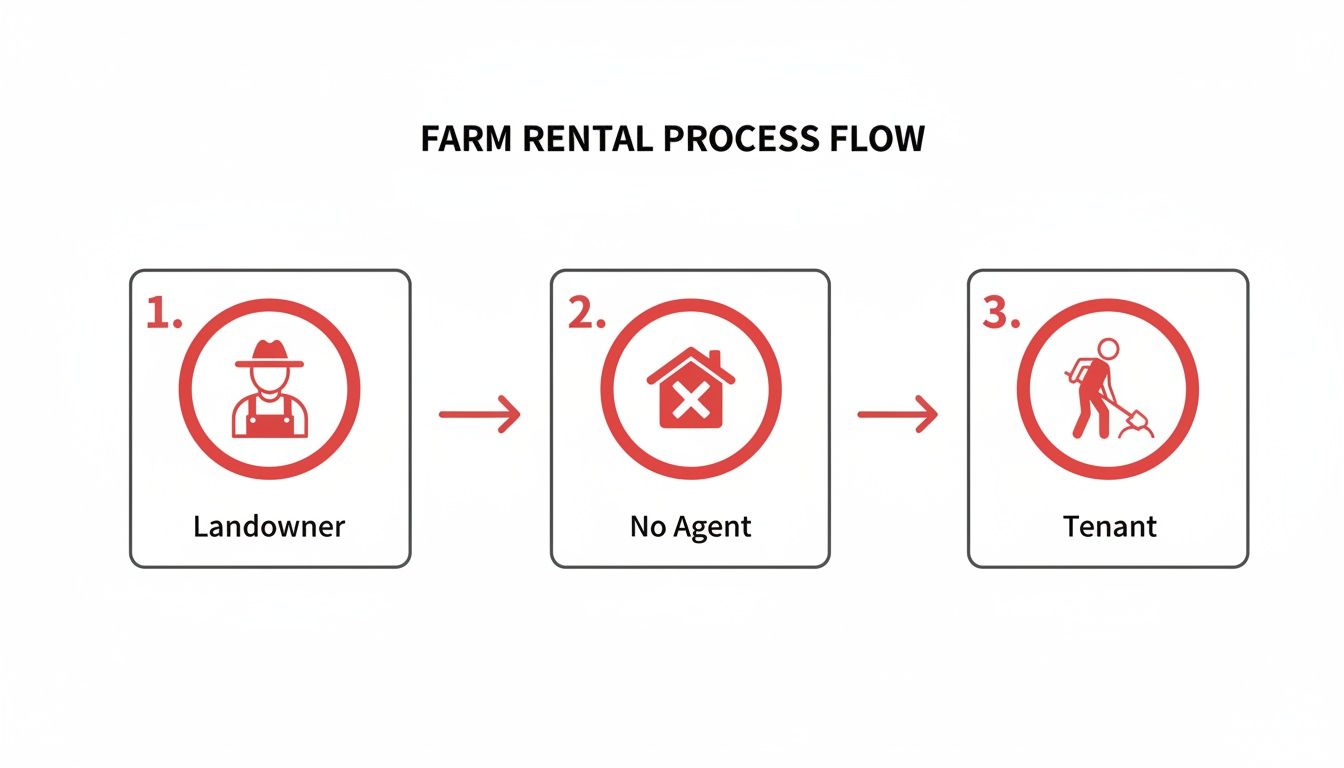
The takeaway here is simple: cutting out the agent saves time and money, creating a better deal for everyone involved.
The market is always shifting. We're seeing that while older tenancy agreements are being adjusted, the more flexible Farm Business Tenancies (FBTs) are holding strong, with projections for 2026 showing continued demand. This move towards modern FBTs gives both landowners and tenants more negotiating power, especially when you're not paying agent fees.
Your On-Site Evaluation Checklist
Once you've got a shortlist, an on-site visit is non-negotiable. What you see in pictures is rarely the full story. A systematic check ensures you don’t get caught out by any expensive surprises. This actionable checklist is crucial for any potential buyer or tenant. You can even get a high-tech overview by exploring how to use drones for agriculture to assess land conditions.
Your boots-on-the-ground inspection needs to cover a few key areas:
- Soil Health and Type: Is the soil right for your plans? Get a spade out and dig a few test pits. You're looking for things like compaction, drainage, and topsoil depth. A light, loamy soil is great for veg, but heavy clay might be better for pasture.
- Water Access and Rights: This is a big one. Check the reliability and legality of any water source. Is it mains, a borehole, or a river? You absolutely must confirm the water abstraction licences and any restrictions, particularly in dry spells.
- Existing Infrastructure: Take a hard look at the state of fences, gates, and any outbuildings. Are they genuinely usable, or are they a money pit waiting to happen? Don't forget to check road access—can you get heavy machinery in and out all year round?
A classic mistake is just assuming that barn is ready to go. A leaky roof or a fence that won't hold your livestock can wipe out any savings you made on the rent.
Understanding Land Use and Restrictions
It's not just about the soil and the sheds, though. You have to dig into the paperwork and find out what schemes or restrictions are tied to the land. These can completely change what you're legally allowed to do.
Ask the landowner directly about any Environmental Stewardship or Countryside Stewardship agreements. These often come with strict rules, like not ploughing certain fields or maintaining low-input grasslands, which could scupper your business plan.
Also, check for planning designations or any public rights of way that cross the property. Sometimes a field that looks perfect for one thing is actually better suited as something else, like a secure yard. You can explore these alternative options by looking into renting outdoor space. A bit of detailed homework now saves a world of headaches later and ensures the land can actually deliver on its promise.
Decoding Agricultural Tenancy Agreements
So you’ve found the perfect patch of land. The soil looks good, the location is right, and you can already picture your enterprise thriving. But before you get ahead of yourself, it’s time to talk about the paperwork.
A solid tenancy agreement is what turns a handshake into a secure business arrangement. It’s the foundation for your relationship with the landowner, protecting both of you by setting crystal-clear expectations from day one. In the UK, agricultural tenancies aren't a one-size-fits-all deal, so getting your head around the legal side of things is essential.
You’ll mainly come across two types of agreements: Farm Business Tenancies (FBTs) and the much older Agricultural Holdings Act (AHA) tenancies. Knowing which is which isn't just a technicality—it completely changes the rights and responsibilities you’ll have.
FBT vs AHA: What You Need to Know
If you’re looking at a new tenancy today, you’ll almost certainly be dealing with a Farm Business Tenancy (FBT). These were introduced by the Agricultural Tenancies Act 1995 to bring a bit more flexibility to the sector. An FBT can be for almost any duration, from a short-term let of under two years to a long-term agreement that runs for decades.
This flexibility is their biggest selling point. It means tenants and landowners can hammer out terms that genuinely work for their business plans. Thinking of diversifying into a farm shop or glamping? An FBT can be tailored to allow for it. For landowners listing their ground on platforms like NoAgent.Properties, a clear, well-structured FBT makes their land far more appealing to a wider pool of tenants, helping them let their property without paying fees.
On the other hand, Agricultural Holdings Act (AHA) tenancies are the old guard—agreements that started before 1 September 1995. These are much more rigid and give tenants incredible security, often including lifetime tenure and the right for close family to succeed them. It's very rare to come across a new AHA tenancy these days, but if you're a landowner with an existing one, your position is very different.
For anyone starting fresh, you can bet you’ll be signing an FBT. This gives you more wiggle room to negotiate, but it also means you have to be much more diligent about what’s actually written in the contract, as fewer terms are set in stone by law.
Essential Clauses Every Lease Must Contain
Think of your FBT as the official rulebook for your tenancy. Whether you’re the farmer or the landowner, getting these details locked down now will prevent massive headaches later. Ambiguity is your enemy here.
Your agreement absolutely must cover these key points:
- The Term Length: This needs to be precise, with exact start and end dates. For any fixed term over two years, a notice period of at least 12 months is automatically required to end the tenancy on its expiry date.
- Rent and Rent Reviews: The agreement must state the starting rent and, crucially, how and when it will be reviewed. FBTs typically allow for reviews every three years, but you can agree on a different schedule. Make sure the method—whether it’s based on open market value or a set formula—is clearly spelled out.
- Repair and Maintenance Obligations: Who fixes what? The lease has to explicitly divide the responsibilities for looking after buildings, fences, gates, and drainage. Landlords usually handle the big structural stuff, while tenants take care of day-to-day upkeep.
- Land Use and Restrictions: What, exactly, can you do on the land? If you have plans beyond traditional farming, like opening a farm shop or hosting events, the lease must give you permission.
Taking the time to check these clauses is time well spent. A good way to get a feel for standard terms is to browse a variety of listings for land for lease on direct platforms, where you can see what other landowners are offering.
Break Clauses and End of Tenancy Rules
What if things change? A long-term FBT can feel like a big commitment, which is why including a break clause is a smart move. This gives either the landlord or the tenant the option to end the agreement early, as long as they provide the agreed-upon notice. It's a valuable safety net if your business plan isn't working out or market conditions shift unexpectedly.
Finally, every good agreement has a clear exit strategy. It must detail what happens when the tenancy ends, including how to handle dilapidations—any damage or disrepair that goes beyond normal wear and tear. It should also cover the tenant's right to be compensated for improvements they’ve made, like boosting soil health or installing new drainage, provided they followed the proper procedures before starting the work. A clear end-of-tenancy protocol ensures everyone parts ways on professional and fair terms.
Setting the Right Rent and Negotiating Your Terms
Getting the rent right for farm land is a classic tug-of-war. Landowners want a solid return on their asset, while tenants need a rate that keeps their business in the black. Nail this from the outset, and you’re building a partnership on solid ground; get it wrong, and you’re setting yourself up for future headaches.
For landowners, this all starts with some honest market research. Plucking a figure out of thin air is a fast way to either leave money on the table or have your advert sit there gathering dust. Your first port of call should be checking out what similar plots are going for in your local area.
How Landowners Can Determine a Fair Rental Price
To land on a competitive rent, you need to be brutally honest about what your land actually offers. Not all hectares are created equal, and good tenants will scrutinise every last detail.
The big-ticket items that really move the needle on rental value are:
- Land Quality and Grade: There's no getting around it—prime arable land (Grade 1 or 2) will always fetch a premium over lower-grade pasture. Know your land's classification and be upfront about its soil health.
- Acreage and Layout: It’s not just about the total size, but how usable the space is. Are the fields well-shaped with easy access for modern machinery, or are they a fragmented, awkward mess?
- Infrastructure and Facilities: A well-maintained barn, a reliable water source, or sturdy fencing can seriously boost what you can charge. If a tenant needs to pour their own money into getting these things up to scratch, your asking price has to reflect that. If you’ve got extra buildings, think creatively – you could even market them separately for things like secure storage options to sweeten the deal.
By listing your farm land for rent for free on NoAgent.Properties, you're immediately cutting out agent commissions. This gives you the freedom to offer a sharper rate to tenants while still putting more of the income directly into your pocket. It’s a win-win for UK sellers avoiding fees.
Building a Strong Case for Your Offer as a Tenant
If you're looking to rent, you need to do more than just agree on a price. You need to sell yourself as the right person for the land. It’s about presenting a professional, compelling case that shows you’re a safe pair of hands.
Before you even think about negotiating, get your business plan in order. Be ready to talk about what you plan to grow or raise, your track record, and your financial projections. A landowner is far more likely to be flexible with someone who has a sustainable plan and will look after their property.
Don’t just ask for a lower price – justify it. This is an actionable insight for buyers. If the fencing needs a total overhaul or the water access is poor, use these points to negotiate. You could push for a lower starting rent or even a rent-free period to cover your initial costs.
Market trends show that Farm Business Tenancy (FBT) rents often see stronger growth than older agreements, with big differences from region to region. This is crucial intel for both sides. When you’re dealing directly through a platform like NoAgent Properties, you can use this real market data to bypass agent talk and agree on a rate that’s fair. To get a feel for the numbers, you can dig into the historic farm rents data from GOV.UK.
Accounting for Subsidies and Environmental Payments
Finally, the tenancy agreement must be crystal clear about who handles agricultural subsidies and who gets the payments from environmental schemes.
If the land is already part of a Countryside Stewardship scheme, the tenant has to be able and willing to meet all the obligations. As a rule of thumb, the person actively farming the land and taking the financial risk is the one who should claim the Basic Payment Scheme (BPS) or its successor. Get this sorted upfront to ensure there are no misunderstandings and everyone stays compliant.
Advertise Your Farm Land for Rent: Your Free Listing on NoAgent Properties
Ready to find the right tenant for your land without watching your profits disappear into high-street agent fees? Using a direct platform like NoAgent Properties puts you squarely in the driver's seat. It's your chance to advertise your farm land for rent for free and connect straight with the people who want to work it.
By cutting out the middleman, you keep full control, save thousands in commission, and build a transparent relationship from day one. This is the smart way for UK property owners to sell or let their land.

The best part? The process is simple. You don’t need to be a tech wizard—just have the details of your land ready and a clear idea of the tenant you're looking for.
Creating a Free Listing That Gets Noticed
First up, you'll want to head over to NoAgent.Properties and create your free account. This is your personal dashboard where you can build, edit, and manage your adverts without ever paying a penny. The aim here is to create a listing that’s both informative and genuinely appealing to UK buyers and tenants.
Think of your listing as a sales pitch for your land. Start with a headline that gets straight to the point. Something like "50 Acres of Quality Arable Land for Rent Near York" or "Secure Grazing Pasture with Barn Available in Somerset" immediately tells a potential tenant if it’s what they’re searching for.
Writing a Compelling Land Description
This is where you bring your land to life for a prospective tenant. Don't just list the basics; showcase what makes your acreage stand out. A well-structured description makes it easy for farmers to quickly scan for the information that matters most.
Try breaking your description down into these key areas:
- Land Overview: Kick off with the total acreage, its current use (e.g., arable, pasture), and the soil type if you know it. If the land has a high grade, make sure to mention it.
- Infrastructure: Give the full picture on any buildings like barns, sheds, or workshops, and be honest about their condition. Don’t forget to detail the quality of the fencing, gates, and any internal tracks.
- Water and Utilities: This is a deal-breaker for any farmer. Be crystal clear about the water source and its reliability. If you have mains electricity or other services on-site, highlight it.
- Access: How is the land reached? Is it directly off a B-road or down a private track? Can large agricultural machinery get in and out easily, even in the depths of winter?
Your free listing is your chance to shine. Instead of just saying "has a barn," try "Includes a 2,000 sq ft dry-storage barn with concrete floor and mains electricity, perfect for machinery or feed." Specifics sell, and on NoAgent.Properties, you avoid fees, so you can focus on creating the best ad.
It also pays to know your local market. Historical data shows that Farm Business Tenancy (FBT) rents can vary dramatically by region, with some areas seeing sharp increases. For anyone using NoAgent.Properties, this is a huge advantage. A direct platform lets you react quickly to local market trends and set a competitive price, all without fees eating into your income. You can get a better feel for pricing by exploring these UK farm rent trends.
Choosing the Right Photos and Managing Enquiries
Good photos aren't just a nice-to-have; they're essential. Your images need to tell a visual story, giving a real sense of the land and its facilities.
Make sure to include:
- Wide-Angle Shots: These capture the scale of the fields and the general lie of the land.
- Infrastructure Close-Ups: Get clear, honest pictures of any barns, water troughs, and fencing for farms.
- Access Points: Snap a photo of the main entrance and any key internal tracks.
- Boundary Markers: If you can, show the fence lines, hedges, or streams that mark the edges of the plot.
Once your free listing goes live, enquiries will start coming directly to you. A quick response shows you’re a professional and serious landowner. Be ready to answer questions and arrange viewings. This direct line of communication is priceless for vetting applicants yourself and finding a tenant who’s the perfect fit for your land.
Finalizing the Deal and Managing the Tenancy
You've walked the fields, shaken hands, and agreed on the terms. Now comes the crucial part: getting it all down in writing and setting the foundation for a successful tenancy. This is where diligence and clear communication turn a good agreement into a great long-term partnership.
Before a single signature goes on the dotted line, it's vital for landowners to do their homework with thorough reference checks. This isn't about being nosy; it's smart business to confirm your new tenant has a solid history. And for tenants, it’s your chance to feel confident you’re dealing with a reliable and professional landowner.
When you're managing the let yourself on a platform like NoAgent.Properties, you're in the driver's seat. This direct approach lets you vet applicants personally, ensuring they’re the right fit for your land while saving a bundle on agent fees.
Creating the Record of Condition
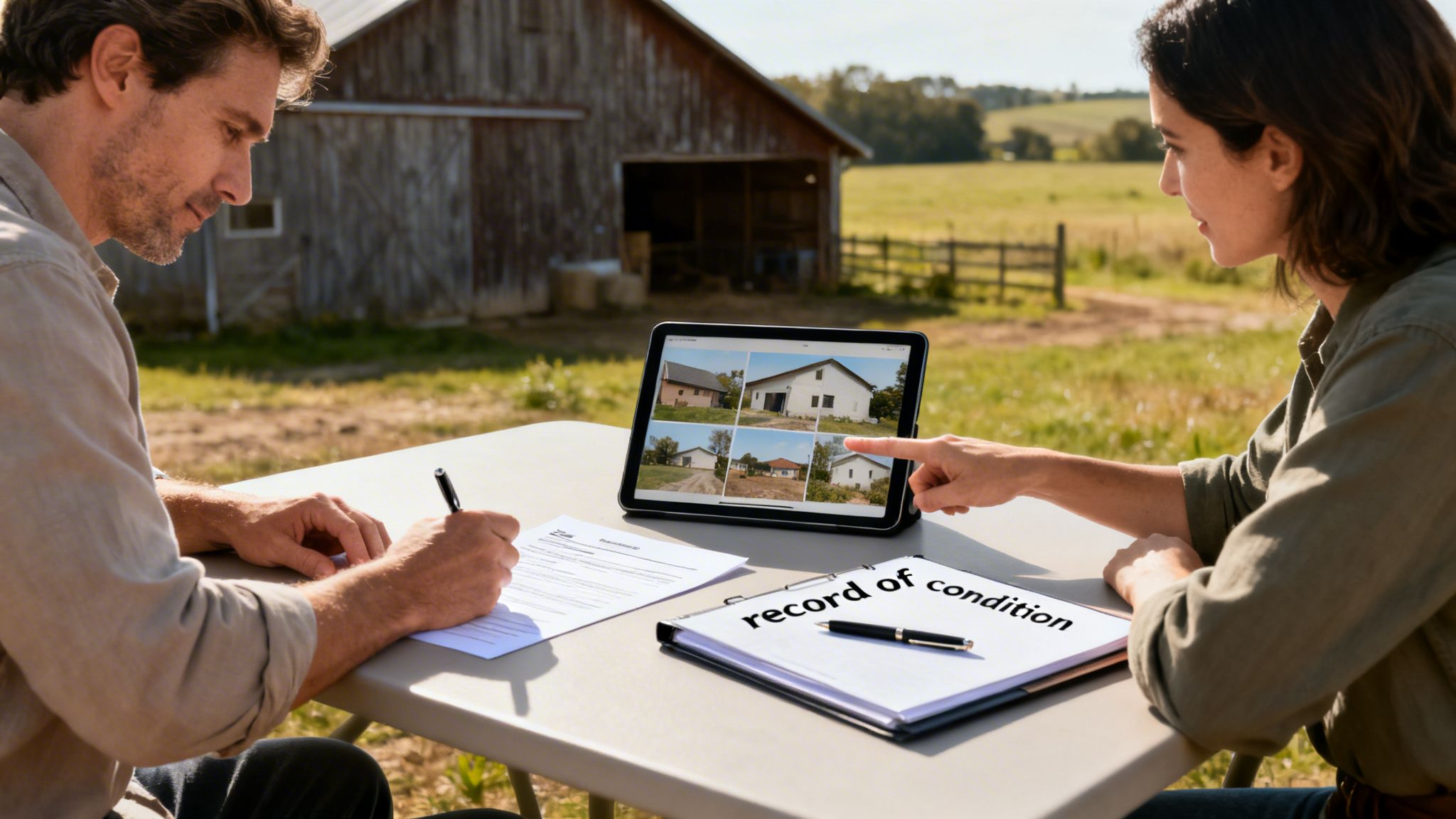
One of the most important things you'll do before the tenancy starts is create a detailed Record of Condition. Think of it as a 'before' snapshot of the entire property, complete with dated photos and clear descriptions. This document is your best defence against future disagreements.
Walk the land together and meticulously note the state of everything:
- Fencing and Gates: Is there any existing wear and tear? Document any wobbly posts, sagging wire, or broken latches.
- Buildings and Structures: Get photos of the inside and outside of every barn, shed, and yard. Make a note of any cracks, damp patches, or other structural quirks.
- Land and Tracks: Check the condition of access roads, identify any compacted areas, and inspect drainage ditches.
Once complete, both parties should sign and date it. This document is invaluable for sorting out what’s fair wear and tear versus what's actual damage when the tenancy eventually comes to an end.
A detailed Record of Condition isn't just paperwork; it’s a preventative measure. It protects the tenant from being blamed for pre-existing issues and secures the landowner’s asset against future damage, creating a foundation of mutual respect.
Ongoing Tenancy Management
With the keys handed over, the focus shifts to maintaining a positive and professional relationship. For landowners, this means having a straightforward way to collect rent and dealing with any genuine issues promptly. This active management is a key responsibility when you choose to sell or let without an agent.
For tenants, it’s all about farming the land as agreed, paying rent on time, and keeping the landowner in the loop about any major problems. A quick phone call can stop a small misunderstanding from turning into a big headache.
By actively managing your tenancy, much like you would a large self-contained secure yard, you build a strong partnership that works for everyone.
Your Farm Land Rental Questions, Answered
Got questions about renting out or finding farm land in the UK? We’ve put together some quick, straightforward answers to the most common queries we see from landowners and farmers alike.
How Much Does It Cost to Rent Farm Land in the UK?
This is the big question, and the honest answer is: it varies massively. The rental cost for UK farm land hinges on everything from its location and soil quality to the state of the fences and buildings.
As a rough starting point, you might see basic grazing land go for under £150 per hectare. On the other end of the scale, top-quality arable land in a sought-after area could easily fetch over £300 per hectare. The real key is to do your local homework. See what similar plots in your immediate area are renting for to get a solid benchmark before you make an offer or set your price.
What’s the Difference Between an FBT and an AHA Tenancy?
You’ll almost certainly be dealing with a Farm Business Tenancy (FBT). These were introduced back in 1995 and are the modern, flexible standard for agricultural lettings. FBTs can be set for almost any length of time and allow for diversification, giving both parties the freedom to agree on terms that actually work for them.
The other type, an Agricultural Holdings Act (AHA) tenancy, applies to agreements made before 1 September 1995. You won't see new ones being created. These are far more rigid and give tenants huge security, including rights to lifetime tenure and even succession for family members. They’re a relic of a different era.
Can I List My Farm Land for Rent Without an Agent?
Yes, absolutely. In fact, it’s becoming the go-to method for savvy UK landowners who want to save money and keep control. Using a free listing platform means you can cut out the agent and their commission fees completely.
With a platform like NoAgent Properties, you can advertise your farm land for rent entirely free of charge. You get to connect directly with potential tenants, vet them yourself, and manage the whole process on your own terms. It means you keep 100% of the rent you earn.
What Should I Check Before Renting a Plot of Land?
Never sign on the dotted line without doing your homework first. This actionable insight for potential buyers and tenants can save you a world of headaches and unexpected costs down the road.
Your checklist should always cover these essentials:
- Water Access and Rights: Where does the water come from? Is the supply reliable? Are there any legal limits on how much you can use?
- Soil Type and Health: Get your hands dirty. Is the soil genuinely suitable for what you plan to grow or graze?
- Existing Infrastructure: Take a hard look at the condition of all fencing, gates, buildings, and access tracks. Will they need immediate, costly repairs?
- Access Routes: Can you actually get your machinery in and out, whatever the weather? Check for any tight corners or boggy patches.
- Environmental Restrictions: It's vital to ask about any stewardship schemes or special designations. These could seriously limit what you’re allowed to do with the land.
Getting these details right ensures the land is a good fit from day one. And if you're thinking about buying instead of renting, you can get a feel for the market by looking at listings like this land for sale near Liphook.
Ready to find the perfect tenant for your land without the agent fees? With NoAgent.Properties, you can list your farm land for rent completely free and connect directly with interested farmers across the UK. Take control of your rental, avoid fees, and maximise your income by visiting https://www.noagent.properties today.
Leave a Reply
You must be logged in to post a comment.