Thinking of investing in a block of flats for sale? It’s a serious power move for any UK property buyer. Getting into multi-unit properties can fast-track your portfolio's growth and lock in a steady stream of rental income like nothing else.
Unlike juggling single-let properties, a whole block brings all your income streams under one roof. This creates serious economies of scale when it comes to management and maintenance. This guide is your no-nonsense, actionable walkthrough for the entire journey, from finding a diamond in the rough to managing your new asset for years to come.
Why a Block of Flats Makes Sense in 2026

Buying an entire block of flats isn't just about adding more doors to your portfolio—it's a calculated business decision. The real prize is consolidating your investment. You simplify your management and create a powerful income-generating machine all in one go. No more running between properties scattered across town; you centralise your time, costs, and returns.
For any sharp UK investor, this approach brings some standout advantages:
- Supercharge Your Portfolio: Snapping up multiple units in a single transaction is hands-down the quickest way to scale your rental holdings.
- Build a Stronger Cash Flow: With several rental incomes flowing from one asset, your cash flow becomes far more resilient and predictable.
- Unlock Economies of Scale: It's just plain cheaper and more efficient to manage and maintain one building than it is to look after several individual properties.
- Gain Total Control: If you own the freehold, you're in the driver's seat. You dictate service charges, set the maintenance schedule, and approve any building-wide upgrades.
Reading the Market for Opportunities
The UK housing market is currently offering up a unique window for savvy buyers. In late 2025, official government data showed that flats and maisonettes saw an annual price dip of 1.8% in England, with the average price falling to £219,000. For anyone looking to sell a block of flats for sale, that climate makes avoiding huge agent fees—which can hit anywhere from £2,190 to £6,570 on just one flat—a very smart move.
This slight market cooling is a buyer's dream. It gives investors more room to negotiate and the chance to buy assets below their peak value, paving the way for serious capital growth when the market bounces back.
What’s more, selling property without an agent has gone from a niche idea to a mainstream strategy. Platforms like NoAgent.Properties are designed to connect buyers and sellers directly, cutting out the expensive middleman. This lets sellers keep more of their equity by avoiding fees, and helps buyers uncover deals they won't find anywhere else. You can get a feel for the types of deals out there, like this residential and commercial investment opportunity, by browsing direct listings.
And once you’ve secured your investment, you’ll want to run it efficiently. Exploring the best property management apps on the market can be a total game-changer, helping you streamline everything from rent collection to maintenance requests.
How to Find and Value a Block of Flats

If you're serious about finding a great deal on a block of flats for sale, your first move should be to look where most other buyers aren't. Forget scrolling endlessly through the same old high-street agent listings. The real opportunities, especially for multi-unit buildings, are often found by going direct to the seller.
The best-kept secret among savvy UK property investors? Cutting out the middleman. This is where you find opportunities that haven't hit the mainstream market, giving you a crucial head start.
A perfect example is searching on a free listing site like NoAgent.Properties. Here, owners list their properties directly to avoid paying thousands in agent fees. It’s a transparent marketplace where you can discover everything from small converted houses to purpose-built blocks, and you get to speak directly with the person who knows the building inside and out—the seller.
Uncovering Off-Market and Direct Listings
To find a genuinely good deal, you have to think beyond the big property portals. Relying only on those means you're just another face in the crowd, competing for the same stock as everyone else.
Instead, expand your search with these proven methods:
- Private Listing Platforms: Sites like NoAgent.Properties, where owners can list for free, are goldmines for buyers. The sellers are often highly motivated, and with no agent chain, negotiations are usually simpler and faster.
- Local Property Auctions: Auctions can be a fantastic place to find blocks needing a bit of work or those being sold by landlords looking for a quick exit. Just make sure you’ve got your financing ready to go before you bid.
- Professional Networking: Start building relationships with local solicitors, accountants, and commercial brokers. They're often the first to hear when a client is thinking about selling a portfolio.
Once you’ve got a potential block in your sights, the real work begins: figuring out what it's actually worth. Valuing a block of flats for sale isn't about gut feelings; it’s about cold, hard numbers.
Mastering Investment Valuation Techniques
Getting the valuation right is your most powerful tool in any negotiation. It stops you from overpaying and, just as importantly, helps you spot properties with hidden potential. For any block of flats, there are two key metrics you absolutely have to master: Gross Rental Yield and Net Initial Yield.
Gross Rental Yield is your quick, back-of-the-napkin calculation. It's great for making initial comparisons between different properties.
Gross Rental Yield = (Total Annual Rent / Purchase Price) x 100
So, if you’re looking at a block of four flats generating £40,000 a year in rent with a £500,000 price tag, your Gross Yield is 8%. It’s a good starting point, but it doesn't give you the full picture.
To get a true sense of profitability, you need the Net Initial Yield (NIY). This is the figure that really matters because it factors in all the running costs. Think insurance, management fees (even if you self-manage, your time has a value!), maintenance budgets, and potential void periods.
The formula is: Net Initial Yield = ((Total Annual Rent – Running Costs) / Purchase Price) x 100
Let’s take that same £500,000 block. If its annual running costs are £8,000, your net rent drops to £32,000. This brings your Net Initial Yield down to a much more realistic 6.4%. This is the number that truly reflects your return on investment.
Digging Deeper for True Value
A proper valuation goes beyond simple yields. You need to investigate the small details that can make or break an investment. Looking at larger listings, like this development opportunity for 21 residential units, can also give you a feel for the market and help benchmark your own calculations.
Critically, you must dig into the building’s legal and financial health:
- Lease Lengths: If the flats are leasehold, this is a big one. Any lease with under 80 years remaining can become a major headache, making the flat difficult to mortgage and expensive to extend. This can seriously drag down the value of the entire block.
- Service Charges and Ground Rents: Get your hands on the service charge accounts. Is there enough in the pot for future major works, like a new roof? Also, watch out for high or escalating ground rents, which can be a red flag for future buyers.
- Rental Growth Potential: Are the current rents at market value? A block with long-term tenants paying below-market rates isn't a problem—it's an opportunity. A light refurbishment and new tenancy agreements can boost your rental income, which in turn directly increases the capital value of your investment.
Securing Finance and Navigating Legal Hurdles
Buying a block of flats isn't like getting a mortgage for your own home. Forget everything you know about standard residential finance—lenders see a multi-unit building as a commercial business, and that changes the entire game.
Your path to getting the funds will depend heavily on your track record as an investor and the condition of the property itself. Lenders aren't just looking at your credit score; they want to see a watertight business plan. If you're new to this, getting familiar with the different ways on how to finance rental property is a great starting point.
This chart breaks down how your investor profile often dictates the best financing route.
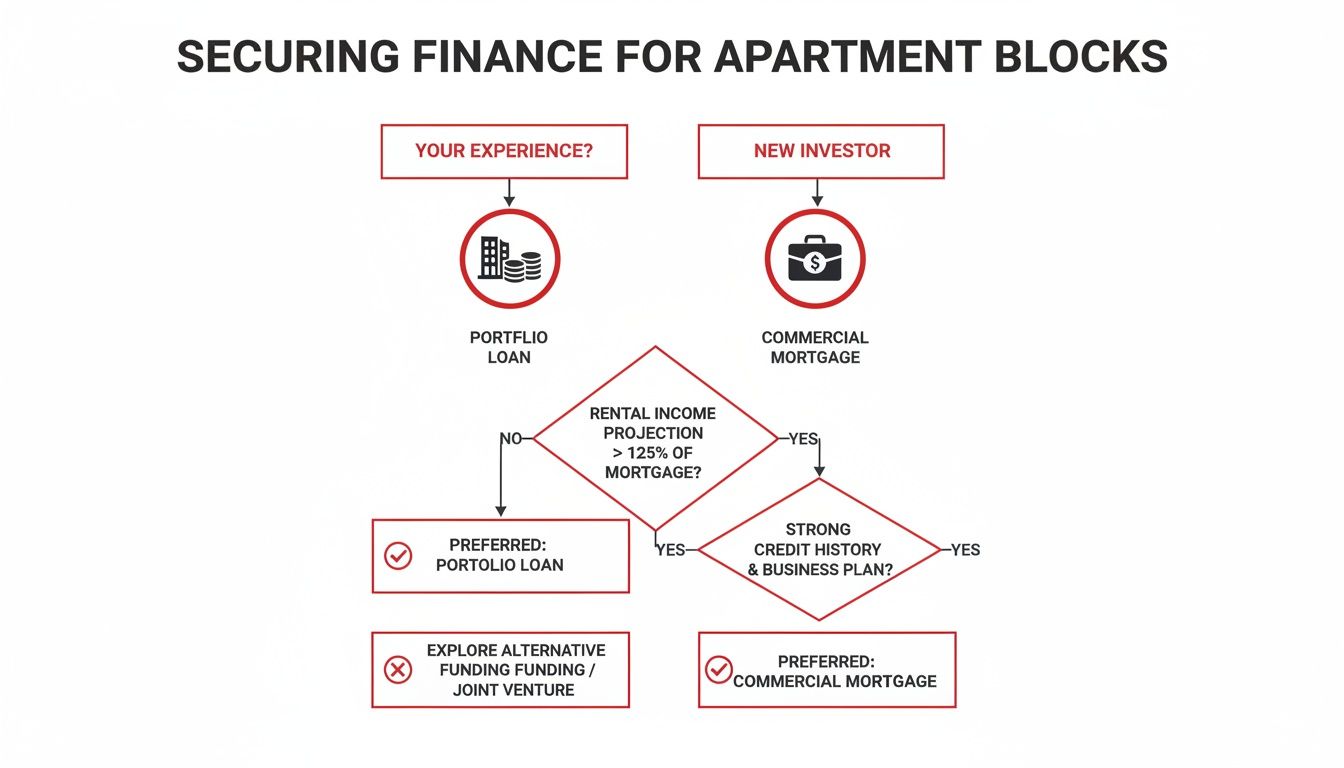
As you can see, lenders have different products for fresh faces versus experienced pros. It's all about managing their perceived risk against your proven ability to deliver.
Choosing Your Financing Route
The right loan can make or break your investment. Get it wrong, and you could see your profits vanish.
A first-time block buyer will almost certainly be pointed towards a commercial mortgage. Think of it as a business loan secured against the property. Lenders will pore over the building’s projected rental income to make sure it more than covers the repayments.
For seasoned investors with a few properties already under their belt, a portfolio loan is usually a much better fit. This lets you leverage the equity you’ve built up in your other properties, often securing you a bigger loan and more favourable terms. To a lender, a proven track record is a massive plus.
But what if the block of flats needs a complete overhaul? This is where short-term bridging finance becomes your best friend. It gives you fast access to the cash needed to buy and refurbish the property. Once the work is done and the flats are let, you simply refinance onto a long-term commercial mortgage.
The Critical Freehold vs Leasehold Distinction
This is arguably the single most important legal point you need to grasp. Are you buying the entire freehold of the building, or just a collection of individual leaseholds? The difference in control, responsibility, and profit is huge.
-
Buying the Freehold: This is the gold standard. You own the building and the land it stands on, outright. You get total control over management, maintenance, service charges, and ground rent. It’s your ship to steer, allowing you to run it efficiently and maximise its value.
-
Buying Multiple Leaseholds: In this setup, you own the individual flats but not the building. You’re still a tenant to a freeholder (the landlord), which means paying ground rent and service charges. You have very little say in how the building is run, which severely limits your control and potential income.
A freehold block is a self-contained business asset. A collection of leaseholds is just a series of individual investments that rely on an external landlord. My advice? Always aim for the freehold.
Your Legal Due Diligence Checklist
Before a single penny is transferred, your solicitor needs to do their homework. This is where you uncover any hidden problems that could sink your investment later on. Don't even think about cutting corners here.
Your solicitor's checklist absolutely must include:
- Verifying Legal Title: Making sure the seller actually has the right to sell the property and that there are no nasty surprises like unexpected charges or restrictions attached to it.
- Reviewing Tenancy Agreements: Going through every single Assured Shorthold Tenancy (AST) agreement with a fine-tooth comb. Are they legally sound? Is the rental income what the seller claims it is?
- Checking Deposit Protection: Confirming that every tenant's deposit has been properly registered in a government-backed scheme. Getting this wrong can lead to hefty fines.
- Inspecting Compliance Paperwork: You need valid copies of the Electrical Installation Condition Report (EICR), all Gas Safety certificates (CP12s), and the Energy Performance Certificates (EPCs) for every flat. No exceptions.
Sometimes, a project's potential is so great that it justifies navigating a more complex legal setup. Take this Edwardian house with planning permission for seven bedrooms, for instance. Here, a deep dive into the approved plans is non-negotiable.
Understanding Your Stamp Duty Liability
Finally, you have to get your Stamp Duty Land Tax (SDLT) calculation right. Because you’re buying several homes in one go, you might be eligible for something called Multiple Dwellings Relief (MDR).
MDR lets you calculate the SDLT based on the average price per flat, not the total purchase price. This can lead to massive tax savings. For example, buying four flats for £1 million would be treated for tax purposes as four separate purchases of £250,000, which dramatically lowers your overall bill. Your solicitor is key here—they will calculate this and claim the relief for you, ensuring you don't get hit with an unexpected tax demand down the line.
Your Pre-Purchase Due Diligence Checklist
So, you've found a promising block of flats and the numbers look good on paper. Now what? This is where the real work begins—the deep dive that separates a great investment from a financial nightmare.
Once you move past the initial valuation, your pre-purchase due diligence is everything. It's about uncovering the building's true condition to avoid any expensive surprises down the line. Think of yourself as a property detective; it's your job to look for the clues that tell the real story.
While your solicitor will handle the legal heavy lifting, you need to drive the practical and commercial side of the investigation.
Getting Hands-On: The Physical Inspection
First things first, you need to get a clear, unbiased picture of the building's physical state. An initial walkthrough is fine, but for a multi-unit block, investing in professional reports is non-negotiable. It's a small upfront cost that can genuinely save you tens of thousands later.
I'd focus on getting professional eyes on these areas:
- Full Structural Survey: This is the big one. A chartered surveyor (RICS) will inspect the property from the foundations to the roof, flagging any issues with the walls, structure, and overall integrity.
- Roof and Windows: Pay very close attention here. Replacing a roof or all the windows across an entire block is a massive expense. If you haven't budgeted for it, a project like that can completely wipe out your returns for years.
- Common Areas: Don't forget to scrutinise the hallways, staircases, lifts, and any other shared spaces. Worn-out common parts are often a sign of poor management and can be costly to modernise.
A word of advice: Never rely solely on the seller's information or a basic mortgage valuation survey. Commission your own independent reports. A surveyor working for you has a duty of care to you, not the seller or the lender.
Checking the Paperwork: Leases and Tenants
With the physical side assessed, it's time to dig into the paperwork that defines your income stream. Your solicitor will check the legal formalities, but you need to understand the commercial reality of the tenancy situation.
Make sure you get clear answers on these points:
- Tenancy Agreements: Go through every single Assured Shorthold Tenancy (AST) agreement. Are they all current? Do the rental amounts match what the seller claimed? Keep an eye out for any unusual clauses or short-notice break clauses.
- Rent Payment History: This is non-negotiable. Ask for a detailed rent schedule going back at least 12 months. This is your proof of income. It will also immediately highlight any tenants who are constantly in arrears—a huge red flag.
- Tenant Disputes: Ask the seller directly about any ongoing or recent disputes. Your solicitor should also make formal enquiries. Walking into an existing conflict can be incredibly draining, both in time and money.
The Financial Health Check
A block of flats runs like a small business, so you need to audit its finances before you take over the keys. This is all about looking at the service charge accounts and any money set aside for future works.
A well-run building should have a healthy sinking fund (sometimes called a reserve fund). This is a pot of money, collected over time from service charges, specifically for big-ticket items like a roof replacement or lift modernisation.
If there’s no sinking fund, or if it’s seriously underfunded, you are essentially buying a future liability. You’ll either have to inject a huge sum of cash yourself or slam the tenants with a massive service charge bill, which is a surefire way to start disputes and cause payment problems.
Looking Beyond the Bricks and Mortar
Finally, lift your head up and look beyond the property itself. What’s happening in the local area can have a massive impact on your investment’s future value and rental demand.
It is absolutely vital to check the local authority’s planning portal for any new developments nearby. A new transport link could send values soaring, but a noisy construction site next door could make your flats a nightmare to let for years.
It’s also smart to see what else is possible. For instance, spotting future potential like this airspace development opportunity can give you a sense of where the area is heading. This is a simple online check that takes just a few minutes but gives you priceless insight into what’s on the horizon.
How to Sell Your Block of Flats Without an Agent

Selling your block of flats for sale privately is a savvy move. It puts you in the driver's seat, controlling both the process and, more importantly, the profit. When you sell without an agent, you’re not just cutting out a middleman; you're avoiding thousands in fees and opening a direct line to serious, professional investors.
The secret to a successful private sale isn't luck—it's preparation. Get this bit right, and you'll have qualified UK property buyers queuing up and be in a prime position to maximise your final price.
Getting Your Asset Ready for Market
Before you even think about putting your property on the market, you need to get your house in order—physically and on paper. Serious buyers will expect a well-maintained building backed by organised, transparent paperwork.
First things first, compile a comprehensive sales pack. This isn't just a 'nice to have'; it signals that you're a professional seller and gives buyers the confidence they need to move fast.
Your sales pack should have:
- Tenancy Schedule: A clear breakdown of all flats, showing current rent for each unit, tenancy start dates, and deposit details.
- Legal & Compliance Docs: Copies of all Assured Shorthold Tenancy (AST) agreements, along with valid EICRs, Gas Safety certificates, and EPCs for every flat.
- Service Charge Accounts: A minimum of three years' worth of accounts to show how funds are managed and the health of any sinking fund.
Next, walk the property and tackle any obvious physical snags. A bit of peeling paint in a hallway or a flickering light might seem trivial, but to a buyer, it can scream neglect. Small, low-cost fixes can make a huge difference to buyer confidence and your block’s perceived value.
Setting a Compelling Price Tag
Pricing a multi-unit block is part art, part science. Go too high, and you’ll scare off the very investors you want to attract. Too low, and you're just leaving cash on the table. The trick is to use the same valuation methods the pros do to land on a price that’s both attractive and realistic.
Start by calculating your Gross and Net Initial Yields from the current rental income. Then, dig into recent sales of comparable blocks in your area to benchmark your own valuation. And don't forget to highlight the "reversionary potential"—that’s the opportunity for a new owner to increase rents to current market rates, which is a direct route to adding value.
By presenting a clear, data-backed valuation, you justify your asking price and immediately filter for knowledgeable investors who understand the asset class. This shifts the conversation from haggling over price to discussing the investment's solid fundamentals.
Marketing to the Right People
With your property prepped and priced, it's time to get it seen by the right audience. This is where you can really outperform an agent by going straight to the source. The smartest move? Listing your property for free on a dedicated platform.
A site like NoAgent.Properties lets you advertise your block of flats for sale with zero listing fees and no commission. That immediately puts you at an advantage, as the thousands you save can give you that extra bit of flexibility when it comes to negotiation.
Your listing is your sales pitch, so make it count.
- Top-Notch Photos: Get bright, clear photos of the building's exterior, the common areas, and at least a sample of the flats.
- A Powerful Description: Lead with the numbers that matter: total rental income, gross yield, and the number of units. Then detail the property's features and location perks.
- Showcase the Upside: Be explicit about any opportunities for rental growth, refurbishment, or other ways a new owner can add value through active management.
Recent data shows the market is buzzing. With a 29.5% year-on-year surge in residential property transactions in the UK early in 2026, buyer activity is high. By listing for free on a platform like NoAgent.Properties, you can tap into this demand without handing over a huge slice of your equity. You can explore a full breakdown of these UK property transaction trends to see the current opportunity for yourself.
Handling Viewings and Offers
Once the enquiries roll in, your job is to manage them like a pro. You'll be talking directly to buyers, from individuals to company directors, so be ready to answer detailed questions on the spot.
On viewings, give them a tour of the common parts and a representative selection of flats. Have your digital sales pack ready to send over. This kind of transparency builds trust and puts you in a powerful negotiating position.
If a quick, certain sale is your top priority, you might want to specifically target a cash buyer. You can discover more about how to attract a cash house buyer in our related guide.
Got Questions About Buying or Selling a Block of Flats?
Dipping your toes into the world of multi-unit properties always brings up a few key questions. Whether you're hunting for your first block of flats for sale or you're a seller looking to get the best possible price, getting clear, straight answers is vital.
We’re cutting through the noise to tackle the questions we hear most often. We’ll cover how to finance your purchase, what to do about existing tenants, and the big one: how you can sell your property yourself and avoid paying thousands in agent commissions.
How Should I Finance My Purchase?
First things first: financing a block of flats isn't like getting a mortgage for your own home. Lenders see it as a commercial investment, and the rules are different. The best route for you will really come down to your own finances and your experience as a landlord.
For most people, especially if this is your first big property investment, a commercial mortgage is the go-to option. Lenders will be laser-focused on the building’s rental income to make sure it can easily cover the repayments. Expect to put down a larger deposit than you would for a standard buy-to-let.
If you’ve already got a few properties under your belt, a portfolio loan could be a much better deal. This lets you secure the new loan against the equity you hold in your other properties, which can unlock better rates and more flexible terms. And for a block that needs a complete overhaul? A short-term bridging loan is your friend. It gives you the cash to buy and renovate, and once the work is done and the flats are let, you can refinance onto a long-term commercial mortgage.
Here’s a pro tip that can save you a lot of headaches: talk to a specialist commercial finance broker. They live and breathe this stuff. Unlike a high-street bank, they have access to a huge range of lenders and know exactly what’s needed to fund a block of flats, finding you the most competitive deal out there.
What Happens to the Existing Tenants?
When you buy a block with tenants already in place, you’re not just buying bricks and mortar—you’re inheriting tenancy agreements and becoming a landlord from day one. The great news is that the rent starts rolling in immediately, which is a massive plus for you and your lender.
Your solicitor will play a key role here. During the legal process, they need to do some serious digging into all the tenancy paperwork. This includes:
- Checking that all the Assured Shorthold Tenancies (ASTs) are legally sound.
- Confirming every tenant's deposit has been properly protected in a government-approved scheme.
- Making sure those deposits are officially transferred over to you when the sale completes.
It is absolutely vital to get a look at the payment history for every single tenant. You need to spot any red flags like late payments or ongoing disputes. And remember, you can't just ask tenants to leave. You are legally bound by their contracts and have to follow strict procedures if you ever need to regain possession.
Is a Vacant or a Tenanted Block Better?
There’s no magic answer here—it all depends on your strategy, your cash reserves, and how hands-on you want to be.
A fully tenanted block gives you instant, predictable cash flow. It’s a lower-risk play that makes lenders happy. The flip side? You’re stuck with the current rental rates, which might be below the market average, and you don’t get to vet the tenants yourself.
On the other hand, a vacant block is a blank canvas. It’s the perfect chance to refurbish the units, hand-pick your ideal tenants, and set fresh, market-level rents right from the start. This approach can seriously boost the building's value and your long-term yield. The catch? You need enough capital to fund the renovations and cover the bills during the empty "void period" before the rent starts coming in.
Can I Really Sell Without an Estate Agent?
Yes, you absolutely can—and for a block of flats for sale, it’s often the smartest and most profitable way to do it. A traditional estate agent can charge you tens of thousands in commission, taking a huge bite out of your profit.
By selling privately, you’re in the driver's seat. Platforms like NoAgent.Properties let you list your property completely for free, putting it directly in front of serious, motivated investors. This direct-to-buyer approach cuts out the middleman, saving you commission fees that typically run from 1% to 3% of the final sale price.
Of course, a successful private sale is all about good preparation. You’ll need to put together a solid sales pack with tenancy agreements, compliance certificates, and floor plans. Great photos are non-negotiable, as is a compelling description that focuses on the numbers investors care about—like total rental income and gross yield. By managing the viewings and enquiries yourself, you build a direct relationship with buyers, which helps build trust and leads to a much smoother negotiation. You’ll still need a solicitor for the legal side, but by cutting out the agent, you keep all the control and all the profit.
Ready to take control of your property transaction? Whether you're buying or selling a block of flats, NoAgent.Properties provides the tools you need to connect directly and avoid costly agent fees. List your property for free or find your next investment today.
Leave a Reply
You must be logged in to post a comment.